How to start forex trading as a beginner in 2026 with a step-by-step plan
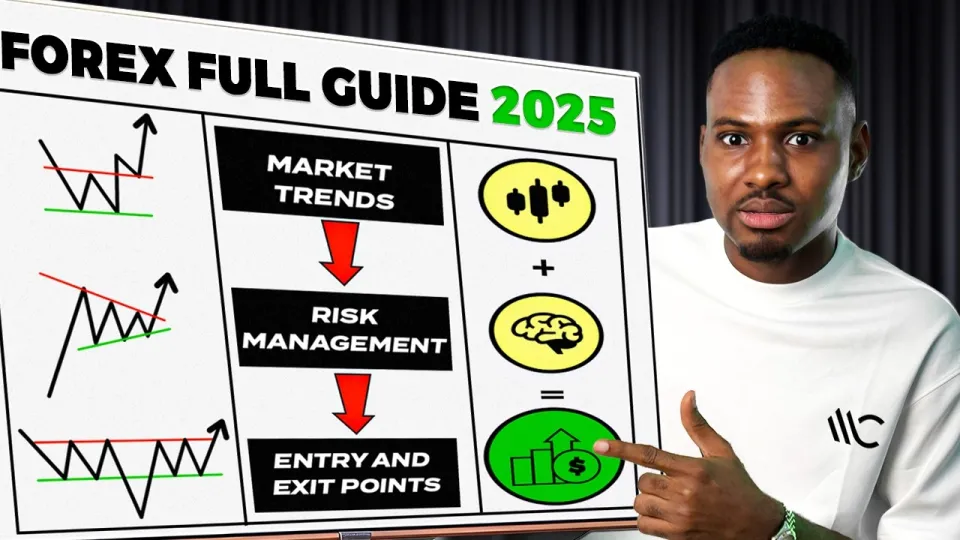
Video: How To Start Forex Trading For Beginners’ 2025 (Full Course)
Need articles like this for your video? They help promote it on YouTube and Google — order them in the Telegram bot @sat_sit_bot. It writes articles around your video, embeds the video and publishes them on popular niche websites (no ads). Free trial — 50 articles.
· based on the channel Jeffrey Benson Forex
Forex trading for beginners starts with three decisions: pick a regulated broker, open a demo account and learn one simple setup before risking real money. Currency pairs are quoted in pairs, positions are sized in lots, and the whole job reduces to a repeatable process — analysis, entry, stop-loss, position size and review. The full beginner course from Jeffrey Benson Forex walks through the same sequence, from what the market is to placing a first trade.
What forex trading actually is and how currency pairs are quoted
Forex is the market where one currency is priced in another, and every quote is a ratio between two economies. A pair like EUR/USD at 1.0850 means one euro buys 1.0850 US dollars; the first currency is the base, the second is the quote currency. When you buy the pair you are effectively long the euro and short the dollar, and when you sell it you do the reverse.
Three mechanics matter more than any indicator for a new trader:
- Pip — the standard unit of price movement, usually the fourth decimal (0.0001) for most pairs and the second decimal (0.01) for pairs quoted in yen.
- Lot — the position size. A standard lot is 100,000 units of the base currency, a mini lot is 10,000 and a micro lot is 1,000; most beginner accounts should trade micro lots.
- Leverage and margin — leverage lets you control a position larger than your deposit, and margin is the collateral the broker holds. Leverage magnifies both gains and losses, which is why position sizing comes before strategy.
Spreads and commissions are the cost of doing business. On a major pair such as EUR/USD a raw spread might be a fraction of a pip plus a commission per lot, while a standard account folds the cost into a wider spread. Beginners should compare total cost, not just the headline spread.
How the forex market works across the four trading sessions
The forex market is decentralised and runs continuously from the Sydney open on Monday to the New York close on Friday, passing through four sessions. Sydney and Tokyo cover the Asian hours, London takes over in the European morning, and New York overlaps London for a few hours — the window where volume and volatility usually peak.
Session awareness solves a practical beginner problem: the same strategy behaves differently at 3 a.m. and at 3 p.m. A breakout that works during the London–New York overlap may chop during the quiet Asian afternoon. Most beginners are better off trading one session consistently, ideally one that fits their waking hours, than trying to watch the chart around the clock.
Market drivers are equally important. Central bank interest rate decisions, inflation prints such as CPI, employment data such as US non-farm payrolls and geopolitical headlines all move currencies, often within seconds. An economic calendar is not optional equipment — it is how you avoid being in a position when a scheduled release detonates the chart.
The tools a beginner needs before the first trade
The tool stack for forex is deliberately small, and the skill is in using each item consistently rather than collecting more of them.
- A regulated broker. Check the licence, the regulator (FCA, ASIC, CySEC and similar), client fund segregation and withdrawal terms before depositing anything. The course recommends a specific broker through its own registration link, but the checklist above should be applied to any broker you consider.
- MetaTrader 5. MT5 is the standard platform for charting, order placement, stop-loss and take-profit management and historical testing; it connects to your broker account through a login and server name.
- A demo account. Trade the same size and the same rules on demo as you intend to trade live. A demo that is treated as a game teaches nothing.
- An economic calendar. Free calendars list upcoming releases with forecast and previous values, so you can plan around them.
- A trading journal. Record the pair, session, setup, entry, stop, target, result and a one-line reason for every trade. Patterns in your own data beat any guru's opinion.
A notebook or spreadsheet is enough to start. The point is a written record you can review weekly, not a dashboard.
A simple strategy foundation and how to place a first trade
A workable beginner strategy needs three answers: where is the trend, where is the entry, and where is the trade wrong. A common structure is to define direction on a higher timeframe, such as the four-hour or daily chart, then look for entries on a lower one, such as the one-hour, in the same direction. Support and resistance, moving averages or simple market structure all serve the same purpose: they tell you where price has reacted before.
Placing the first trade follows a fixed order:
- Choose one pair, ideally a liquid major such as EUR/USD.
- Mark the higher-timeframe trend and the nearest levels.
- Wait for price to reach a level and show a reaction, rather than chasing a candle mid-move.
- Set the stop-loss at the level that invalidates the idea, not at a round number that feels comfortable.
- Calculate position size from the stop distance and the risk budget, then enter with a take-profit at a logical target.
The arithmetic is simple. If a $1,000 account risks 1% — $10 — and the stop is 20 pips away, the position should be sized so that 20 pips equals $10, which on a micro lot is roughly 0.05 lots. This single calculation does more for survival than any entry technique.
Common beginner mistakes and the questions new traders keep asking
Most beginner losses trace back to a short list of repeatable errors rather than bad luck. Risking 5–10% per trade, trading without a stop-loss, adding to losing positions, switching strategies after two losses and trading during major news are the usual suspects. Over-leverage is the accelerant: a 1:500 account can open a position ten times too large for its balance in a single click.
A second cluster of problems is psychological. Beginners often treat a demo win streak as proof of skill, then discover that real money changes the decision-making. Others consume dozens of hours of tutorials without ever journaling a trade, which is why so many viewers of long-form courses report understanding risk management only after writing it down. The fix is unglamorous: one setup, fixed risk, a written record and a weekly review.
Expectations deserve the same honesty. Forex is not a shortcut to a monthly income in the first year; the realistic early goal is to stop losing money and to build a process you can repeat. Anyone promising guaranteed daily profits from copied signals should be treated with caution — copying trades removes the learning, and it does not remove the risk.
Useful links from the course
- Become a student on Fire Pips FX — the paid mentorship and course plans.
- Free daily signal channel — one free trade idea per day on Telegram.
- Broker registration used in the course — the recommended broker sign-up link.
- Premium signal group access — subscription bot for the premium group.
The bottom line on starting forex trading
Starting forex trading well is a sequence, not a secret: understand the pair mechanics, learn when the market is liquid, keep the tool stack minimal, size every position from a fixed risk budget and journal the results. The beginner course from the Jeffrey Benson Forex channel is a useful spine for that sequence because it moves from market basics through tools and strategy to a first trade and the mistakes that undo beginners. Use it as a curriculum, not as a promise, and pair it with a demo account and a written plan before any real capital goes in. The Fire Pips FX plans page is where the structured version of that curriculum lives if you want to follow it step by step.
Key takeaways
- Forex is an over-the-counter market where currencies are quoted in pairs such as EUR/USD; there is no central exchange and trading runs 24 hours a day from Monday to Friday.
- Four sessions — Sydney, Tokyo, London and New York — overlap during the London–New York window, which is typically the most liquid part of the day.
- A beginner's toolkit is short: a regulated broker, MetaTrader 5, a demo account, an economic calendar and a trading journal.
- Risk per trade should stay near 1% of account equity, so a $1,000 account risks about $10 on a single position.
- Jeffrey Benson Forex's full beginner course covers market basics, tools, strategy foundations, a first trade and common mistakes.
Questions & answers
How much money do I need to start forex trading?
You can open many accounts with a few hundred dollars, and micro lots make a $500–$1,000 balance workable for learning. The more important number is risk per trade: at 1% of a $1,000 account you are risking about $10 per position, which keeps a normal losing streak survivable.
Is forex trading legal and safe for beginners?
Forex trading is legal in most countries, but safety depends on the broker's regulation rather than on the market itself. Check for a recognised licence, segregated client funds and clear withdrawal terms, and treat any promise of guaranteed returns as a red flag.
How long does it take to become profitable?
There is no fixed timeline, and anyone quoting one is guessing. A realistic path is several months on demo and small live size while building a journal, with the first goal being consistent rule-following rather than consistent profit.
Should I copy signals instead of learning to trade?
Copying trades can show you how entries and exits look in practice, but it does not teach position sizing or risk control, and it transfers the drawdown to your account. Use signals as a study aid while you build your own process on a demo account.
Source: How To Start Forex Trading For Beginners’ 2025 (Full Course) · Markdown version